The Transparency Dilemma IA
Since August 2, 2026, Article 50 of the EU's Artificial Intelligence Act has been in force. And while the industry is still figuring out where to stick the label, almost no one is asking the only question that actually matters: what does the public do with that label once they see it?
The answer is more unsettling than expected.
What Actually Applies
Last week, a client sent me a visual. Their bottle sitting on a table, with an AI-generated sky behind it. "Do I need to add the disclosure?" No. The product is real, and the backdrop doesn't mislead anyone about the product.
Two days later, another client shows me a customer-testimonial video. Faces, voices, first names. Entirely generated. That one, yes. And not just a little.
That's roughly the whole logic of the regulation, summed up in two examples. What matters isn't how much AI you used. It's whether someone could believe they're looking at something real when they're not.
There are exemptions, but they're narrower than people make out. Minor edits (light cropping, color correction, noise reduction, grammar fixes) aren't covered. Altering a silhouette or a skin tone, on the other hand, is. An AI-generated backdrop behind a real product passes, as long as it doesn't mislead about the product's appearance.
That leaves the real way out, for text: the obligation falls away if the content has undergone human review or editorial oversight, with editorial responsibility taken by an identifiable person. The bar is high: a substantial review by someone competent, not a spell-check. And any substantial AI modification made after that review voids the exemption.
The Paradox No One Saw Coming
Every survey has said the same thing for three years: the public wants to know. In the largest study available on the subject, conducted by Getty Images among more than 30,000 adults across 25 countries:
- Nearly 90% of consumers say they want to be informed when an image is AI-generated.
- 98% believe that the authenticity of images and videos is decisive for the trust they place in a brand.
- And 76% admit they can no longer tell the difference.
The regulator listened. Logical, democratic, hard to argue with.
Except there's a second body of research, far less cited, that says exactly the opposite. In a series of thirteen pre-registered experiments involving more than 5,000 participants, published in 2025 in Organizational Behavior and Human Decision Processes, researchers (Oliver Schilke and Martin Reimann) measured what happens to someone who announces they used AI. The result is uncomfortably consistent: whoever discloses is systematically judged less trustworthy than whoever stays silent. A professor who admits having AI grade papers drops from 2.96 to 2.48 on the trust scale. A startup founder who admits it drops from 5.63 to 4.55 — a full point. All six disclosure wordings tested produced the same effect. Voluntary or mandatory, it makes no difference.
The authors call this the transparency dilemma. The term is well chosen. The public demands information that, the moment it's given, damages the relationship.
But the thirteenth experiment is the one to remember, because it measures all three scenarios side by side. Say nothing: 4.02 trust. Disclose voluntarily: 3.15. Say nothing and get exposed by a third party: 2.49. Admitting it costs you. Getting caught costs you twice as much. In other words, you're not choosing between a cost and no cost. You're choosing between a moderate cost and a severe one.
Why This Doesn't Mean Your Campaigns Are Doomed
This is where the public debate gets it wrong, and where there's an edge to be gained.
In May 2026, MediaScience and the Ehrenberg-Bass Institute tested four labeling formats on 900 American viewers, against a control group with no label. The result flatly contradicts the prevailing panic: no significant difference from the control on brand choice, ad recall, likeability, or perceived production quality. Better still, on unaided brand recall, all three text formats beat the control: 60–61% versus 54%.
Only one variant loses, and it's telling: the icon alone. It caps out at 44% positive brand attitude, versus 51% for the control. It's also the worst at getting people to understand AI was used: 38%, barely better than the 36% of the group with no label at all. It fails, simultaneously, at informing and at protecting the brand.
The delicious detail: it's precisely the format consumers say they prefer, by a thirteen-point margin over the others. What people like isn't what works — advertisers know that tune well.
So who's right? Both — and that's the whole point. These studies aren't measuring the same thing. Schilke and Reimann measure interpersonal trust: an individual, a relationship, an implicit promise of human effort. MediaScience measures the performance of a thirty-second spot, an object no one ever believed was hand-painted.
The operational conclusion fits in one line: the label doesn't punish AI. It punishes authenticity that was promised and not delivered.
The risk isn't proportional to the dose of AI. It's proportional to how much humanity the format led people to expect.
What Happens Next
In the short term, expect a fear response. Legal departments will over-label, because the perceived cost of an unnecessary disclosure is zero, while a missing one can run into the millions. We'll see labels on crops, on color corrections, on things the regulation explicitly exempts.
Three to five years out, though, is the extrapolation that interests me most, because it's counterintuitive.
First, the label will become commonplace. Any universal disclosure eventually stops being a signal: it happened with cookie banners, with terms and conditions, with health warnings on packaging. When everything is labeled, the label discriminates nothing. The trust cost measured today is a novelty cost, and it will erode. Generational data already hints at it: according to EMARKETER, 57% of millennials and nearly 50% of Gen Z say they like an ad more after learning it involved AI. The stigma has an expiration date.
Second, and this is the corollary, value will shift from usage to proof. If AI is everywhere and labeled everywhere, what becomes scarce is no longer the content — it's the traceability of its origin. Organic, made-in-France, handmade: every time mandatory labeling has landed on a market, it hasn't killed the industrial producer, it has created the premium segment standing next to it. My bet is that "designed, reviewed, and vouched for by an identifiable team" will become a line of value, then a line on an invoice.
Where to Start
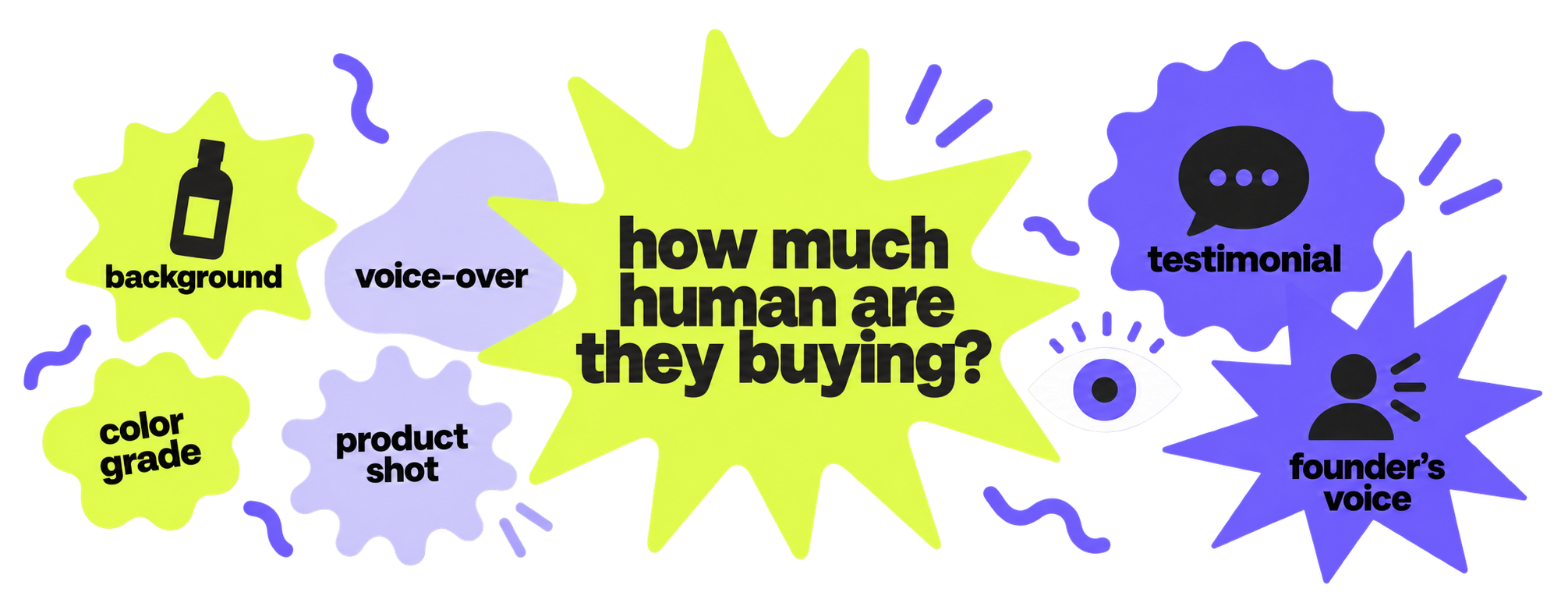
Take the list of what you produce and ask yourself one question, format by format: how much humanity does the audience believe they're buying here?
Where the answer is "none," use AI without hesitation and disclose it without fear. No one will hold it against you. Where the answer is "a lot" — the executive's voice, the client relationship, the testimonial — keep the human real. Not just in the disclosure.
Finally, test your disclosure wording the way you test a headline. The MediaScience study shows a seven-point gap in brand attitude between the best and worst format, on strictly identical content. Seven points is an entire media budget. And remember that the most intuitive format, the discreet little icon, is the one that loses on both counts. The AI disclosure has become a creative element; it deserves the same care as a headline or a call-to-action.
If you'd like clarity on your own content, get in touch. We'll look together at what you produce, and where the real points of caution lie.
Sources
- Getty Images, Building Trust in the Age of AI 30,000+ adults, 25 countries
- Schilke, O. & Reimann, M., The transparency dilemma, Organizational Behavior and Human Decision Processes, vol. 188, 2025
- MediaScience & Ehrenberg-Bass Institute, AI video ad labeling study, May 2026
- EMARKETER, AI in ads isn't the problem for most consumers, lack of disclosure is
- Article 50 of the EU AI Act