Your tracking is lying to you: why server-side tracking is becoming essential performance
For several years now, one conclusion has become increasingly clear in our industry: the data we collect every day is becoming less and less reliable. Not because our tools are poor. Not because our accounts are incorrectly configured. But because the system on which traditional tracking relies, the browser, has become structurally hostile to data collection.
In 2026, it is time to face the issue, understand why client-side tracking is reaching its limits, and take a serious look at what server-side tracking can and cannot solve.
Traditional tracking: built on sand
For years, the setup was simple: install a pixel or tag on your website, let it fire in the user's browser, and send the data directly to Google Analytics, Meta and Google Ads. Convenient, fast and effective.
But this setup relies on an assumption that is becoming increasingly unreliable: that the browser will actually execute the code and transmit the data.
Here is what actually happens today
Browsers actively block or restrict tracking. For several years, Safari has used Intelligent Tracking Prevention (ITP), which can reduce the lifetime of third-party cookies to seven days, or even 24 hours under certain conditions. Firefox follows a similar approach. Chrome, long considered the last stronghold of third-party cookies, has also announced increasingly restrictive measures. The result: sessions are no longer attributed correctly, users "disappear" between visits, and attribution windows close before a conversion even occurs.
Ad blockers are now widespread. Current estimates suggest that 30% to 40% of European internet users use an ad blocker. These tools do more than block ads: they also block tracking scripts, including Google Analytics, Meta Pixel and most third-party tags. What you cannot measure, you cannot optimize.
iOS 14+ changed the game for Meta. Apple's App Tracking Transparency, introduced in 2021, made explicit opt-in consent mandatory for cross-app tracking. In practice, a very large proportion of iOS users decline this tracking. For Meta advertisers, this resulted in significant conversion underreporting: genuine sales were no longer attributed to their campaigns. Reported ROAS fell sharply, while Meta's algorithm optimized against incomplete data.
Google Consent Mode and cookie management have narrowed the measurement window even further. Under the GDPR and consent requirements, a growing proportion of users decline analytics and advertising cookies. That is legitimate and positive for privacy, but it means your GA4 property sees only a fraction of actual traffic. Recent studies estimate that data loss can reach 30% to 50% of traffic, depending on the industry and cookie-banner acceptance rates.
The result? Your dashboards show an incomplete version of reality. Your optimization decisions are based on partial data. Your advertising algorithms learn from degraded signals.
Server-side tracking: what exactly are we talking about?
To understand server-side tracking, we first need to clarify what we mean by "client-side tracking", the traditional model.
- Client-side: The tracking code runs directly in the user's browser (the "client"). When a page loads, the browser executes JavaScript, which sends requests to Google, Meta and other third-party servers. Everything happens on the user's device, within the browser environment, with all its restrictions, blockers and privacy controls.
- Server-side: Instead of sending data directly from the user's browser to third-party platforms, tracking requests are first routed to your own server (or a server environment you control). The server processes the data, enriches it where necessary, and then forwards it to third-party platforms through server-to-server API calls.
The diagram below illustrates the difference
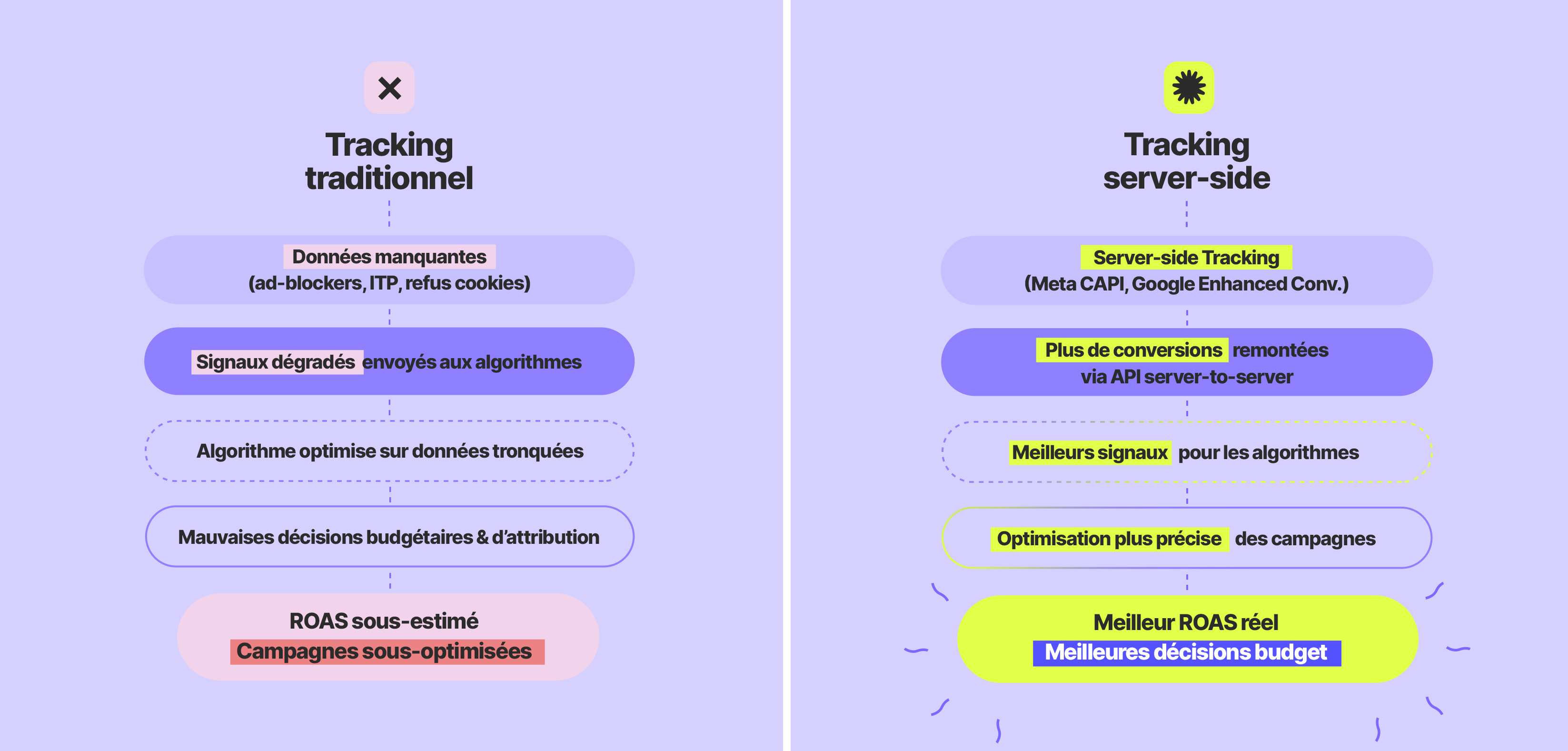
This architectural shift has several important consequences
Ad blockers can no longer interfere with the server-to-server transmission. An ad blocker operates at browser level: it can block JavaScript requests and filter domains known to be used for tracking.
However, it cannot intercept API calls between two servers. Once the data is transmitted server to server, it no longer passes through the user's browser, so the blocker cannot see it.
You regain control of the data before it is sent. With an intermediary server, you can filter, anonymize, enrich or transform the data before it leaves your infrastructure. This is a significant advantage for GDPR compliance: you decide exactly what is shared with third parties and in what form.
Cookie lifetimes can be extended. By using first-party cookies set directly by your domain through your server, you reduce the impact of ITP restrictions on third-party cookies. A first-party cookie can remain available much longer than a third-party cookie subject to Safari's limitations.
Conversions are reported more reliably to advertising platforms. By using each platform's direct APIs, including Meta Conversions API, Google Enhanced Conversions and TikTok Events API, you can send conversion events more reliably, including for users who would otherwise have been "lost" in a purely client-side setup.
It would be misleading to present server-side tracking as a silver bullet. It is not. User consent remains the rule: server-side tracking does not allow you to track people who have refused cookies. It improves data quality for users who have consented and may allow certain aggregated or anonymized signals to be sent for others. This distinction matters.
Why everyone is adopting it in 2025-2026
What is striking is how quickly server-side tracking has moved from a topic reserved for data teams at CAC 40 companies to an issue that now concerns SMEs and agencies.
Several factors explain this rapid adoption.
Google laid the groundwork with GTM Server-Side. Since 2020, Google Tag Manager has offered a server container that moves tagging logic to a server-side environment. It is the best-known entry point into the ecosystem, and Google has gradually made it more accessible.
Specialist providers have grown rapidly. Platforms such as Stape, Addingwell, Tracklution, SignalBridge and Taggrs emerged to solve the main challenge of server-side GTM: infrastructure complexity. They provide hosted and managed server-side containers, so companies do not need to maintain their own cloud instance. Stape, now one of the most widely used providers, offers plans starting at a few dozen euros per month, with preconfigured templates for Meta Conversions API, Google Enhanced Conversions and TikTok Events API. Addingwell stands out for its European positioning, with servers hosted in Europe and a GDPR-focused approach, a strong argument for our Belgian clients.
Major advertising platforms have opened up their APIs. Meta launched the Conversions API (CAPI) in 2020 and has progressively made it easier to implement. Google has rolled out Enhanced Conversions more broadly. TikTok, Pinterest and Snapchat have followed suit. These APIs allow conversion events to be sent directly from the server and matched with platform user profiles using hashed identifiers such as email addresses and phone numbers. This is known as data matching, and it is what improves attribution rates in practice.
Turnkey solutions have emerged for specific CMS platforms. Elevar has focused on Shopify and offers an almost automated implementation of server-side tracking for e-commerce. Littledata offers a similar solution. For e-commerce businesses that need to recover reliable conversion data quickly without rebuilding their entire tracking infrastructure, these tools have been a game changer.
The market has made its position clear: server-side tracking is no longer optional for organizations that are serious about data-driven marketing. It is becoming the standard.
What this means in practical terms for an SME
Let us be direct: implementing server-side tracking requires an investment in time, configuration and, in some cases, subscription costs. It is not trivial. But the benefits are tangible.
When Meta or Google Ads receives less data, its algorithms perform less effectively because they optimize using incomplete signals. By sending more conversions through server-side APIs, you provide higher-quality signals, which can improve campaign optimization in return. It is a virtuous cycle.
Better attribution, better decisions
If your GA4 property captures only 60% of actual traffic, your attribution decisions (which channel is genuinely driving conversions?) are based on a distorted picture. Recovering some of that missing data allows you to make better budget allocation decisions.
A stronger GDPR compliance position
By using an intermediary server to control what is shared with third parties, you gain greater oversight of your personal data flows. That gives you a stronger position when working with your Data Protection Officer (DPO) or your clients.
A short-term competitive advantage. Server-side tracking is still under-adopted among SMEs. Companies that implement it now gain an advantage over competitors that are still waiting.
In practical terms, if you manage Meta or Google Ads campaigns with a significant budget, see major discrepancies between actual conversions and those reported in your advertising accounts, or have low cookie-consent rates, server-side tracking deserves serious consideration.
- Tracking has always been about accuracy. For a long time, accuracy was easy: you only had to install a pixel. Today, maintaining that level of accuracy requires a more robust architecture.
- Server-side tracking is not a passing trend; it is a structural response to structural problems.
The question is no longer really, "Do I need it?" but rather, "When should I implement it, and which solution should I use?"
Do these challenges sound familiar? At In Fine, we help clients audit and optimize their tracking infrastructure. Let's talk: https://www.infine.net/en/contact